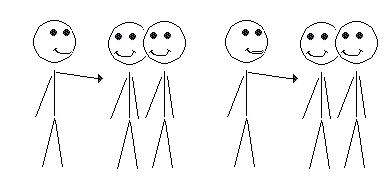
i will next astronauts to the moon from the Indonesian state of the world's first...hahaha..
aku yang akan berikunya menjadi presiden 2040 di USA/ Amerika Serikat.. hahaha
banyak banget sih impian gueh.. hahaha.. tapi ga papa deh. Sekarang bukan tentang bicara cita-cita, tapi penggunaan simple future teman-teman. Kaya contoh diatas termasuk Simple Future, karena memuat kata akan/ shall/will/ be going to, yang biasanya menunjukkan apa yang kita lakukan pada masa depan . Untuk yang lebih lengkap lagi click here !
Simple future is used for describing job or action that will happened in the future. Simple future has two different forms in English: “will” and “be going to”.
Positive (+)
a) S + shall/will + V1
Example:
• I shall write a novel.
• They will play badminton.
• I will go to the market.
b) S + be + going + to + V1
Example:
• I am going to write a novel.
• They are going to play badminton.
• Dheppy is give a present to me.
Negative (-)
c) S + shall/will + not +V1 + O
Example:
• I shan’t write a novel.
• She won’t clean the room.
• You will not help him later.
• I will not take a nap soon.
d) S + to be + not + going to + V1 + O
Example:
• I am not going to party.
• He is not going to visit his grandparents next month.
• We are not going to clean the classroom.
Interrogative
e) Will + S + V1 + O
Example:
• Will you arrive on time?
• Will they want dinner?
• Will he swim very fast?
f) To be + S + going to + V1
Example:
• Am I going to visit my aunt?
• Are you buying a shirt?
• Is he going to write a novel?
Use of simple Future
1. Use “will” to express a voluntary action
Examples:
• I will send you the information when I get it.
• I will translate the email, so Mr. Smith can read it.
• Will you help me move this heavy table?
2. Use “will” to express a promise
Examples:
• I will call you when I arrive.
• I promise I will not tell him about the surprise party.
• I won’t tell anyone your secret.
3. Use “be going to” to express a plan
Examples:
• He is going to spend his vacation in Bandung.
• I’m going to be an actress when I grow up.
• She is not going o spend her holiday in Jakarta.
4. Use “will” or “be going to” to express a prediction
Examples:
• The year 2212 will be a very interesting year.
• The year 2212 is going to be a very interesting year.
• Tukul Arwana will be the next president
Senin, 30 April 2012
Minggu, 29 April 2012
What is Invitation?
Invitation is a way to invite someone or more to go to a place or to do something.
There are two types of invitation.
They are Formal Invitation and Informal Invitation.
-Formal invitation is usually originate from Institutes, Companies and a kind of it. Normally formal invitation is written invitation.
-Informal invitation is personal invitation given to a friend, family, etc. Informal invitation can be written invitation and verbal invitation.
How to Write An Invitation??
Step 1
Before you write an invitation, decide on the tone, voice and level of formality, based on the event itself. This will dictate whether you hand-write the cards or have them printed, and whether you choose A preprinted or personalized invitation.
Step 2
Choose the type of invite you want, and order or buy a few more than you think you'll need. This will permit you to add some guests to your list at the last minute, if necessary. For small parties, you may want to hand-write the invitations on stationery or blank cards. For large gatherings, consider ordering printed invitations.
Step 3
Determine the wording of your invite based on the level of formality. For example, a formal invitation might say, 'Dr. and Mrs. Stanley request the pleasure of your company,' whereas a more casual note might say, 'Please join us.'
Step 4
Include the names of the host and/or hostess, as well as the place (with street address), time, date and purpose of the occasion, even if it's a simple get-together.
Step 5
Make sure to add RSVP information at the bottom of the invite if you need to know who will be attending; for example, 'RSVP' followed by your telephone number.
R.S.V.P. which means "please reply.“The person sending the invitation would like you to tell him or her whether you accept or decline the invitation. That is, will you be coming to the event or not?
Step 6
Include a respond-by date on a formal invitation so you can get an accurate head count in time to adjust the amount of food, number of place settings and room size. For a wedding, charity function or other formal event, consider including a response card and a stamped, self-addressed envelope inside the envelope containing your invite.
Step 7
Mail invitations three weeks before most events, four weeks before a formal affair and three months before a wedding, to allow for airline reservations. For events held during the December holidays, send invitations around Thanksgiving.
There are two types of invitation.
They are Formal Invitation and Informal Invitation.
-Formal invitation is usually originate from Institutes, Companies and a kind of it. Normally formal invitation is written invitation.
-Informal invitation is personal invitation given to a friend, family, etc. Informal invitation can be written invitation and verbal invitation.
How to Write An Invitation??
Step 1
Before you write an invitation, decide on the tone, voice and level of formality, based on the event itself. This will dictate whether you hand-write the cards or have them printed, and whether you choose A preprinted or personalized invitation.
Step 2
Choose the type of invite you want, and order or buy a few more than you think you'll need. This will permit you to add some guests to your list at the last minute, if necessary. For small parties, you may want to hand-write the invitations on stationery or blank cards. For large gatherings, consider ordering printed invitations.
Step 3
Determine the wording of your invite based on the level of formality. For example, a formal invitation might say, 'Dr. and Mrs. Stanley request the pleasure of your company,' whereas a more casual note might say, 'Please join us.'
Step 4
Include the names of the host and/or hostess, as well as the place (with street address), time, date and purpose of the occasion, even if it's a simple get-together.
Step 5
Make sure to add RSVP information at the bottom of the invite if you need to know who will be attending; for example, 'RSVP' followed by your telephone number.
R.S.V.P. which means "please reply.“The person sending the invitation would like you to tell him or her whether you accept or decline the invitation. That is, will you be coming to the event or not?
Step 6
Include a respond-by date on a formal invitation so you can get an accurate head count in time to adjust the amount of food, number of place settings and room size. For a wedding, charity function or other formal event, consider including a response card and a stamped, self-addressed envelope inside the envelope containing your invite.
Step 7
Mail invitations three weeks before most events, four weeks before a formal affair and three months before a wedding, to allow for airline reservations. For events held during the December holidays, send invitations around Thanksgiving.
Example
- Extending (mengundang)
- Let’s go to the Keroncong Festival!
- Please try to come!
- I hope you’ll join us!
- If you are not busy, pleset come to my party!
- Shall we see the film?
- I would like to invite you come to my house!
Accepting
- Great! Let’s do it!
- Thank you. I’d like to!
- That’s a good idea!
- That would be very nice!
Declining /refusing:
- I’m really sorry about that.
- Sorry. I can’t. I have to do something.
- I’d love to. But I can’t.
- Sorry. I really busy.
- (If you declining an invitation, please give a reason)
- Extending (mengundang)
- Let’s go to the Keroncong Festival!
- Please try to come!
- I hope you’ll join us!
- If you are not busy, pleset come to my party!
- Shall we see the film?
- I would like to invite you come to my house!
Accepting
- Great! Let’s do it!
- Thank you. I’d like to!
- That’s a good idea!
- That would be very nice!
Declining /refusing:
- I’m really sorry about that.
- Sorry. I can’t. I have to do something.
- I’d love to. But I can’t.
- Sorry. I really busy.
- (If you declining an invitation, please give a reason)
Sabtu, 28 April 2012
Modal In The Past Form
Modals In The Past Form
When do we use modals?
1. To talk about someone's ability (or inability) to do something
Example: "We can find your house without the street plan."
"She can't have a daughter that old!"
Example: "We can find your house without the street plan."
"She can't have a daughter that old!"
2. To talk about an action that is necessary (or impossible, or not necessary)
Example: "You must always have your driver's licence when you are driving your car."
"You needn't carry your passport around with you."
Example: "You must always have your driver's licence when you are driving your car."
"You needn't carry your passport around with you."
3. To talk about a situation that is possible (or impossible)
Example:"Do be careful with that glass, the baby might knock it over"
Modals in the Past Form
can't have
|
certainty
e.g. I can't have lost my keys! (I'm sure I didn't)
|
permission
e.g. When I was a teenager, I could go out as late as I wanted.
| |
general ability
e.g. Tom could walk by the age of 8 months.
|
possibility, but did not happen
e.g. I could have passed my driving test if I'd really tried.
| |
uncertainty
e.g. I guess it could have been Sandra on the phone.
|
permission
e.g. When I was a teenager, I couldn't stay out as late as I wanted.
| |
general ability
e.g. I couldn't walk until I was 2.
| |
ability in a particular situation
e.g. I tried hard but I couldn't persuade him to go to the party with us.
|
possibility/ability
e.g. I couldn't possibly have passed my driving test, even if I'd tried harder.
| |
uncertainty
e.g. It couldn't have been Sandra on the phone, could it?
| |
with comparative adjectives
e.g. I couldn't have asked for better weather on my wedding day.
| |
unwillingness
e.g. I couldn't have left the dog in the car for long (so I didn't).
|
unnecessary action not done
e.g. As I was alone this weekend, I didn't need to do any cooking (so I didn't).
|
obligation (past form of must)
e.g. I couldn't go out last night because I had to do my homework.
|
uncertainty
e.g. I guess I may have been a bit hard on her when she came home an hour late.
|
possibility (didn't happen)
e.g. You might have been killed!
| |
uncertainty
e.g. I guess I might have been a bit hard on her when she came home an hour late.
| |
annoyance at someone's failure to do something
e.g. You might have told me that you had invited all your colleagues round for dinner!
| |
might have known + would (idiom to ironically express that somebody's action was typical)
e.g. I might have known that he would finish with me as soon as he found out I wasn't wealthy!
|
certainty
e.g. He must have known how much it was going to cost. (I'm sure he knew.)
| |
with surely in exclamations
e.g. Surely he must have known how much it was going to cost!
|
unnecessary action that was actually done
e.g. Oh, you needn't have done the washing up!
|
criticism (more common isshouldn't have)
e.g. You ought not to have been so frank with him.
|
expectation (should have is more common)
Why is she late? She ought to have arrived by now!
|
expectation
Why is she late? She should have arrived by now!
| |
should have + verbs of thinking
e.g. I should have thought you knew.
| |
with be and adjectives, describing chance
e.g. It was weird that you should have been staying in the same hostel last month.
| |
criticism (you didn't do something, but it would have been the right thing to do)
e.g. The party was such fun last night! You should have come!
|
criticism
e.g. You shouldn't have been so frank with him.
| |
polite expression of thanks on receiving a gift or favour
"Here's a bottle of wine for you"
"Oh, you really shouldn't have!"
|
events in the past that did not happen
e.g. I wouldn't have gone out with him, but he didn't ask me.
| |
assumptions
e.g. Oh, that would have been Sarah on the phone just now.
|
would not
|
unwillingness
e.g. I asked Tom to close the window, but he wouldn't do it.
|
PRESENT FORM
|
PAST FORM
|
Can
|
could
|
May
|
might
|
Will
|
would
|
Shall
|
should
|
Must
|
-
|
ought to
|
-
|
Need
|
-
|
Asking for information

Guide de conversation 5 - Informer / s'informer.
Asking for information | -(Excuse me) can could you tell me (the way to the station/...) -Do you know (if they are here / when they leave /...) -Could you give me some information about ... -Is it true that (they have moved /...) -Have you got an idea of (when they leave / ...) -I'd like to know (what he does / ...) |
Correcting agreeing with a statement | -Yes, it is / was / will ... -Oh yes, I did / Oh no, I didn't. -That's (quite) right. -No, it isn't really so. -I'm sorry but that isn't correct. - Well, it's the contrary in fact. |
Asking about language | -Pardon? / I beg your pardon? -I'm sorry I didn't catch what you said. -What do you mean? -What is the meaning of ...? -How do you pronounce..? -How do you say that? -How is it spelt? How do you spell ...? |
Expressing certainty | Being sure. I'm sure / certain (that) (he will come / ...) -There is no doubt about it. -No doubt (you'd like to see your gift / ...) -I certainly think / believe that (she was unhappy / ...) -I'm positive on that point. I'm certain... -It is obvious that ... -That goes without saying. -It's crystal clear. -It's as sure as two and two make four. Being less sure. -I think so -I think that ( they will be there by 6 / ...) -I suppose so. -I suppose / expect that ( it is the way to the bus stop /...) -I believe that ( he is sick / ...) -I assume (that ) (they did it / ...) -It's more than probable that ... -I wouldn't be surprised if .... Being unsure. I'm not sure (that) ... -I wonder if... -I doubt if ... -May be / perhaps (they're right / ...) -It's very doubtful whether (he'll accept / ...) -There's a little chance of ( arriving in time / ...) -It isn't known for use ... Not knowing. -I don't think so. -I don't think that (they will give her a ring / ...) -I don't know / I've no idea / I wouldn't like to say (where it is). -I haven't the faintest idea. -Sorry, I can't tell you. |
Inquiring about certainty | -Are you (quite) sure (that) ... -Do you think so? -Do you think that ...? -Do you believe / suppose that (it's a good idea / ...)? |
Expressing possibility | -It is possible -It is possible (that) (it rains / ...) -I / you ... can (drive / read / ...) -He / we / ... is/are capable of ( doing better / ...) |
Expressing impossibility | -It is impossible -It is impossible (that) (it rains / ...) -I / you ... can't (drive / read / ...) -You can't possibly ( do this / ...) |
Inquiring about possibility | -Is it possible? -Is it possible (that) (he will come / ...) -Will he / she / they .. be able to (do it / ...)? -Can he / she /.... (drive / read /...)? |
Expressing obligation | -You have (got) (to go / ...) -We / you ..must (leave / ...) -Do behave yourself! -It is compulsory. You are to .. (be there at 4 / ...) -We are forced to do so. -We were obliged to (pay / ...) |
Expressing there is no obligation | -It's not necessary / not necessarily. -No) you needn't / you don't need to ... (go out / ...) -No need to (wait / ...) -You don't have to .. (wait / ...) -You haven't got to (wash the car / ...) -It is not compulsory. -It is not absolutely vital. -Why should you? -You aren't obliged to ...(wait for them /...) |
Inquiring about obligation | -Must we ( go / stay /...) -Do you have to ( wash our hands / wait/...) -Have I / we got to ( go now /...) -Is it compulsory? -Am I / Are we required to ( take an exam / ...) -Need we (stay / ...) -Am I to (wait here / ...) ? -Am I obliged to (leave / ...)? -Are we supposed to (read this book / ...)? |
Forbidding, refusing permission | Parking is strictly forbidden / prohibited here. -Trespassers will be prosecuted. -No begging / parking / waiting / ... -They won't let me (go out / ...) -Nobody is to (enter this area / ...) -I was refused permission to ( use my car / ...) -You may not (drink alcohol / ...) -We weren't allowed to (talk / ...) -It's out of question. -Smoking / drinking alcohol .. is not permitted/ is prohibited. |
Kamis, 26 April 2012
Offering
The expression of “ Would you like....”is normally used for offering something to someone.
Maretha: Would you like a cup of tea, Mrs. Ane?
Mrs. Ane: Yes, please. Thank you. Hmmm... this tea tastes good... and smells fragrant too...
Maretha: Thank you. I’m glad you like it.
Offering to older people:
· Would you like a cup of coffee, Mr. Green?
· Should I get you a bottle of water?
· Could I offer you a glass of milk, Mr. kiki?
· Would you care some salad?
Offering to friends:
· Want some?
· Have some?
· Chocolate?
· Glass of lemonade?
· Grab some for yourself.
Less formal expressions:
· Would you like to have a pancake?
· Why don't you have some lemonade?
· What can I get for you?
· What will you have?
Declining an offering
· No, thanks.
· No, really won't, thank you.
· Not for me, thanks.
· No, thanks. I’m not hungry.
Accepting an offering:
· Thank you.
· Yes, please.
· I'd like it very much.
· Thank you, I would.
· That would be very nice.
Vocabulary Around The House
Vocabulary around the house is an situation when we use english for everday in our hole life and we spelled the grammar well. Begin in our daily life at home e.g. with our parents,friends,bro,sister,grandpa,grandma,or maybe with your teachers? then, your neighboor,your lab partner,etc
Attic
People store things in the attic.
Ballroom
A room in stately homes where rich people dance and concerts are held.
Box Room
A small room used for storage.
Cellar
Underneath the house.
Cloakroom
A small room where people put their coats.
Conservatory
A greenhouse attached to a house for the display of plants.
Dining Room
A room where people eat (see eating at home).
Drawing Room
A room in stately homes where rich people entertain.
Games Room
A room in large houses where games are played.
Hall
The entrance passage to a house.
Larder
A small room used for the storage of food.
Library
A room where books are kept.
Lounge
Another name for living room.
Music Room
A room where people play music.
Office
A room where people work.
Pantry
A small room used to store kitchen and dining items.
Parlour
Old fashioned word for living room.
Sitting Room
Another name for living room.
Spare Room/
Guest Room
A room where guests sleep.
Toilet
A room where people go to the toilet (often known as WC)
Utility Room
A room where appliances such as washing machines are used.
Things you may find around the house
Kitchen
* Table(s)
* Chair(s)
* Bin(s)
* Cooker(s) / oven(s)
* Microwave (oven)(s)
* fridge(s)
* dishwasher(s)
* Tap(s)
* Coffee maker(s)
* Food mixer(s)
* Coffee maker(s)
* Food mixer(s)
* Liquidizer(s)
* Saucepan(s)
* Frying pan(s)
* sieve(s)
* Kettle(s)
* teapot(s)
Things we do in the Kitchen
* People prepare food in the kitchen.
* People cook in the kitchen.
* People sometimes eat in the kitchen.
* People make coffee or tea in the kitchen.
* People put the food away in the kitchen cupboards.
Bathroom
* Chair(s)
* Basin(s)
* Bath(s)
* Toilet(s)
* Toilet roll(s)
* Toilet brush(es)
* hairdryer (hairdryers)
* toothbrush(es)
* Shaving foam razor(s)
* Toilet seat(s)
Things we do in the BathRoom
* People get dressed or undressed in the bathroom.
* People have a shave in the bathroom.
* People brush their teeth in the bathroom.
* People take a shower in the bathroom.
* People have a bath in the bathroom.
Bedroom
* Bed(s)
* Bedside cabinet(s)
* Bedside table(s)
* Dressing table(s)
* Wardrobe(s)
* Chest of drawer(s)
* Brush(es)
* Comb(s)
* Hair dryer(s)
* Pillow(s)
* Sheet(s)
* Clothes
Things we do in the Bed Room
* People listen to music in the bedroom.
* People sleep in the bedroom.
* People get dressed or undressed in the bedroom.
Rooms
* Living Room
* Settee(s)
* Armchair(s)
* Coffee table(s)
* Display cabinet(s)
* Hifi stand(s)
* TV cabinet(s)
* Television(s) / tv(s)
* Hifi(s)
* Speaker(s)
* Cushion(s)
* Rug(s)
Things we do in the Living Room
* People watch TV in the living room.
* People sit and read a book in the living room.
* People listen to music in the living room.
Here example dialog about Vocabulary Around The House
It's Saturday and Joan and Steve are decorating.
Joan
Steve, you missed a bit.
And Download Blogger Templates.
Langganan:
Postingan (Atom)